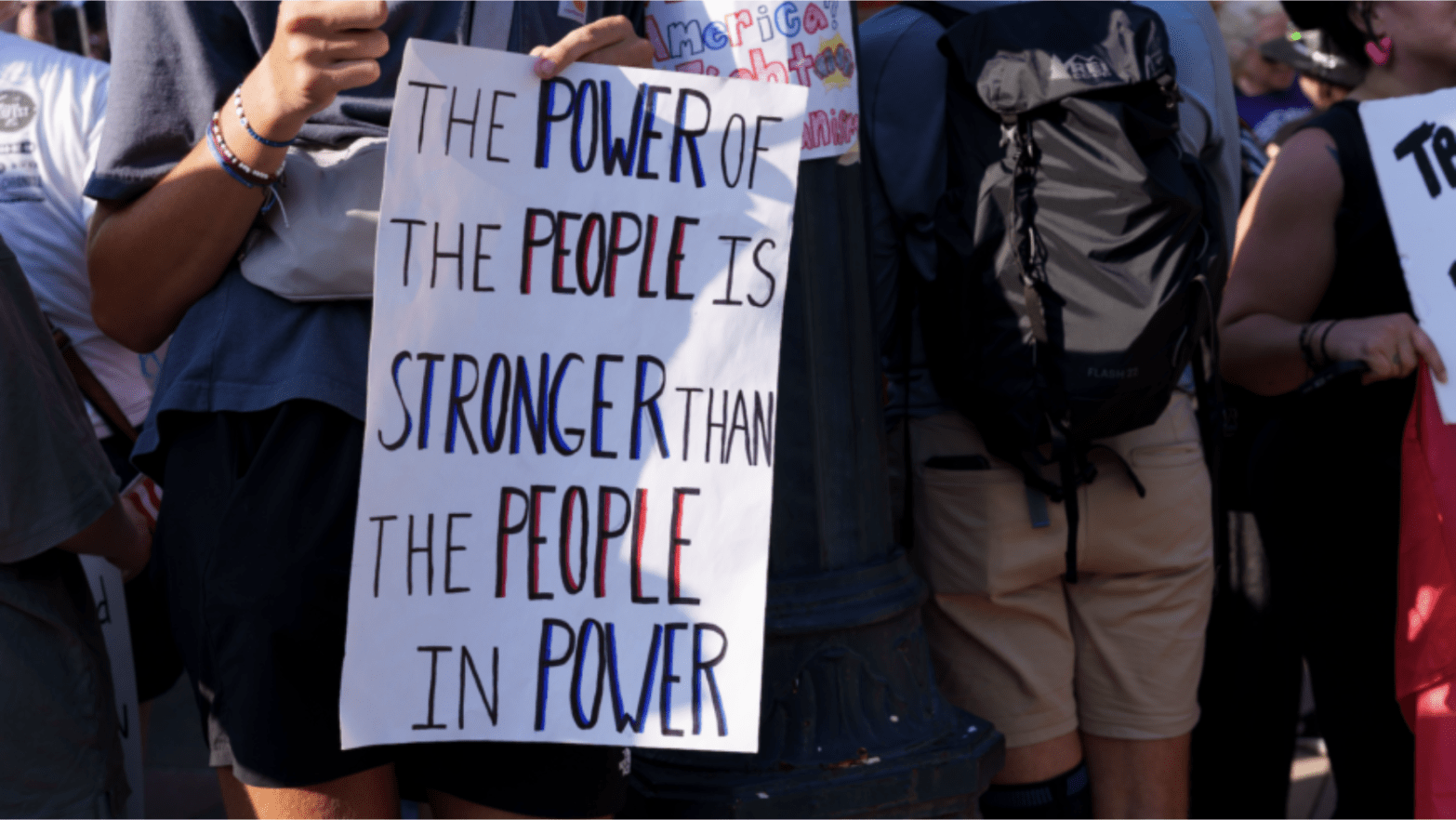
“Power to the People!” John Lennon sang in 1971, bringing music to a slogan that had been chanted and shouted by young people across the US to protest the Vietnam War over the previous few years. Meanwhile, “All Power to the People” was also being chanted by the Black Panthers to protest what they perceived as the rich, ruling class domination of society.
Decades late, in the summer of 2010, at the forefront of the Arab Spring, Egyptian Google executive Wael Ghonim launched an anonymous Facebook page to protest the death of one Egyptian man at the hands of security forces. The page quickly became a focal point for protesters online and in real life. In late January 2011, Ghonim was captured by the government, and held for twelve days of brutal interrogation. Upon his release, he gave a tearful interview on national television; prompting more intense protests. Four days later, Egypt’s president Hosni Mubarak was forced to resign. Ghonim’s memoir of this time, “Revolution 2.0” used as its subtitle a phrase he had used and seen others use: “The Power of the People is Greater than the People in Power” (paraphrased on several protest signs over the years, and included on U2’s recent song American Obituary).
“Power to the People!” “All Power to the People!” “The Power of the People is Greater than the People in Power.”
I wonder how these expressions resonate with you. Are they threats? Charges? Demands? Truisms? Aspirations? Inspirations? Warnings? Perhaps all of the above? Has your reaction to phrases like these changed over your lifetime? If you hold any position of leadership and/or authority, do these phrases impact you differently now than they would have done early in your career?
Putting aside the global political stage, I’m sure we’ve all seen instances where leadership in an organization has made drastic changes that have shocked their staff and/or their clients. Sometimes these changes can happen as part of a large overall change in direction (think of turning an ocean liner – it takes time and can appear to happen very slowly to anyone on board), but we can probably all think of examples where the changes have been sudden and seemed to come out of nowhere. To use the painful analogy of boiling a frog, sometimes leaders simply throw the frog into boiling water and expect it to stay there.
This shock by itself doesn’t always result in a unified response. “Power of the people” relies on a level of organization. If you’ve ever been a member of a professional union, you might have a different view of such organizing than someone in leadership who has only ever encountered unions through disputes and contract negotiations.
Whatever your experience, an organized (lower-case u) union of people can be effective even in relatively-small numbers. In 2013, Erica Chenoweth, Professor of Public Policy at Harvard Kennedy School, famously published research showing that nonviolent protests actively engaging a threshold of 3.5% of the population have historically never failed to bring about change – policy change or, in extreme cases, a change of government itself. But this is not only limited to politics; anyone who remembers the 79-day New Coke failure in 1985 (or, more recently, the 2020 Sonic the Hedgehog movie redesign) knows that not all protests are in the streets.
So what do we do with this? How you think about these ideas – and the actions that might be worth taking – could well depend on where in your life you are a person in power and where in your life you are not. For almost all of us, this is a both/and – even if you’re a person who holds authority or status in one area of your life, there are many other areas where you don’t. How do we each balance those well when thinking about power?
This Week’s Tips:
- For places where you hold some power or authority: Remember the maxim from Spider-Man’s first appearance in Amazing Fantasy #15 (1962) – “With great power, there must also come great responsibility.” Spend time with those you have authority over, build relationships, pay attention to what they care about and what’s important to them. Note: This is not a one-time survey or conversation; this is a long-term investment. Learn about different kinds of power, and focus on building “power with” instead of “power over.”
- For places where you don’t hold power or authority: Engage in conversations with others. Build relationships, pay attention to what they care about and what’s important to them. (If you’re seeing an overlap with the above, that’s intentional.) Look for things you have in common – concerns or passions – and if it feels appropriate, look for activist groups who have organized around the same issues. If these are workplace concerns, you might find ERGs or Affinity Groups who have shared concerns – meet with them to find out any actions already taken, or to see if you can help organize. Or if this is outside the workplace and you don’t find groups already in existence, use a grassroots organizing toolkit to start organizing a group yourself.
Try these out this week, and let us know how it goes – we’d love to hear from you!
As always, you can subscribe to our feed here, or sign up for our weekly newsletter to get these articles directly in your inbox.

