I’m writing this from the window seat of a red eye flight, following a work retreat in Hawai’i, on the island of O’ahu. This was my first time in the state, and I was struck by the vibrancy and beauty of Polynesian culture that stands proud long after American and European businessmen overthrew the monarchy in 1893, which in turn was followed by the US’s annexation of Hawai’i’s in 1898, and Hawai’i’s eventual statehood in 1959. I was surprised to see far less of Disney’s Hawai’i-related characters like Moana, Maui, and Lilo & Stitch in Hawai’i than I do in Massachusetts (though there are several places by the coast with “Moana” in the name; the name Moana simply means “ocean” in Hawai’ian). Meanwhile, statues abound of Hawai’ian historical figures: queens, kings, princesses, and yes, surfers.
(Not so relevant here, but there are wild chickens everywhere on O’ahu – as a chicken-owner myself, it was a strange experience to be hiking through a bamboo forest and then hear roosters crowing from a nearby banyan tree.)
Following one session of the meeting, one attendee commented to me that she appreciated the group being a melting pot: that everybody’s ideas were welcomed and heard, and no one was excluded. I understood what she meant. Organizations and societies that see themselves as a melting pot pride themselves on being made up of people with diverse backgrounds, opinions, and life experiences. The flip side of the melting pot idea is the “melting” part – the expectation that everyone’s unique qualities are simply assimilated into one whole mixture. The accepted norm is conformity rather than authenticity. Think of a blended soup, where each spoonful tastes the same, rather than a salad where you can taste each flavor separately.
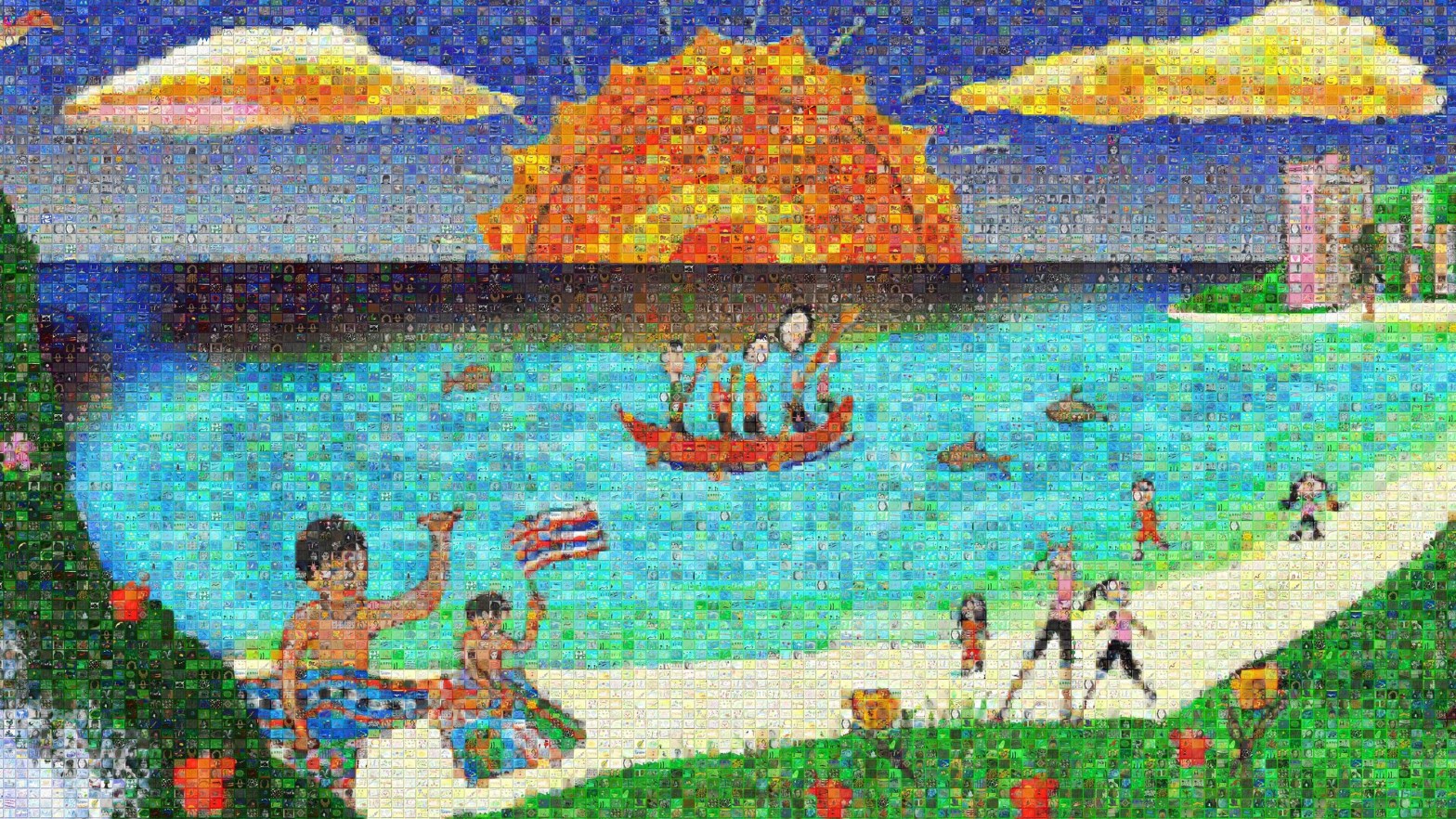
So what’s the alternative to a melting pot? Honolulu’s Daniel K. Inouye International Airport might offer us a suggestion. In terminal 2 (concourse E if you’re interested), a giant mosaic mural is on display (also shown above), made in 2009 to commemorate the 50th anniversary of Hawai‘i’s statehood. The mosaic comprises 8,000 unique images made by K-12 students across the state, focusing on the theme: “Commemorating 50 Years of Statehood: What I Love About Hawai’i.” If you see it in person, you can look at each individual image up close, and step back to see the larger mosaic form a beautiful sunset image.
A lot of the work of Building Bridges Leadership over the years has encouraged teams to be less of a melting pot, and more of a mosaic – inviting them not to become more like each other, but to support each other in becoming more of who they each already are. In a mosaic, each piece of glass or stone shines bright in the color it already brings with it; the pieces around it help it to both stand out and to contribute to something larger. The Hawai’i statehood mosaic goes one step further: each piece tells an individual’s story unique to them. And yet, when all the pieces are placed together, a mosaic encapsulates a vision not displayed by any individual piece. While each piece illustrates the unique diversity of group members, the full mosaic shows the diverse unity of the whole team – what a team is able to be together that they can’t be individually. My hope is that you experience this in teams of which you’re a part, whether you lead those teams or not.
If you’re not experiencing that – or if you have before, but it feels like a distant memory – how can you work towards it this week?
This Week’s Tip:
Work to create a Mosaic, not a Melting Pot – The opposite of an environment of exclusion is not an environment of conforming; it’s an environment of belonging. While melting pots mix elements together to make something assimilated and consistent, mosaics show the value each unique element brings, by placing them alongside each other to create a vivid and colorful image. Each person’s color shines bright, rather than being dulled.
- Look for people’s unique contributions – Think about your colleagues and members of your team. What is each person’s unique contribution to your organization? How can you honor and acknowledge their contribution this week?
- Share more of yourself – In sharing more of yourself, your own story and your own life experiences, you are creating a space for others to do the same. This in turn grows a space of authenticity in your workplace, highlighting people’s unique diversity in all its facets.
- Invite different perspectives – You can implement this at any moment by asking questions like, “What are we missing here?” “What are we not thinking about?” and “What are other ways beyond what we’ve done in the past?” Longer-term, you may want to consider if the range of perspectives in your group is as wide as would be helpful – if not, you can consider partnering with others for a season, and/or hiring for new perspectives.
- Encourage / start affinity groups – Areas of similarity in color can enhance even the most beautiful mosaics. Encourage (or if you are in a position to do so, start!) affinity groups or Employee Resource Groups in your workplace – there is value and support in spending time with others who have some shared experiences, both to build a sense of belonging while honoring what makes each person unique in authentic spaces where people can feel comfortable being themselves.
Try this out this week, and let us know how it goes – we’d love to hear from you!
As always, you can subscribe to our feed here, or sign up for our weekly newsletter to get these articles directly in your inbox.
 Building Bridges Leadership