Last Wednesday morning – about 90 minutes after the Presidential election results were announced – two colleagues and I opened an in-person two-day corporate retreat for 48 senior leaders from around the country and elsewhere in the world. If you read the last few Building Bridges Leadership articles, you won’t be surprised to know that I was prepared to lead activities exploring liminal spaces (which had worked perfectly for the program I led on Election Day itself). I was sure we wouldn’t know a result for several days, as evidenced by the timing of the “While We Wait…” email which landed in subscribers’ inboxes twenty minutes after the election was called… Instead, with the election called, it felt important to focus more heavily on what we all have in common – our shared humanity, unique diversity and diverse unity – and on building bridges, both metaphorically and, later, literally.
The program itself was wide ranging – including high ropes course activities, perspective drawing, orienteering, and team-building challenges. But we bookended the program with two different types of bridge building. To begin, each participant picked a card with an image on it that resonated with them in some way, and shared with a partner a personal story related to it. They would then switch cards with their partner, find a new partner, and share the story they had heard from the original card owner. Then switch cards again, find a new partner, and so on for about five rounds. We came back together in a circle, and each person introduced the original owner of the card they held, and the story behind it. Along the way, we heard meaningful and silly stories, and the stories made their way through a Telephone-like evolution – some details getting dropped, some being added out of nowhere, and some stories having no connection at all to what was originally shared. Lots of laughs, and lots of connection.
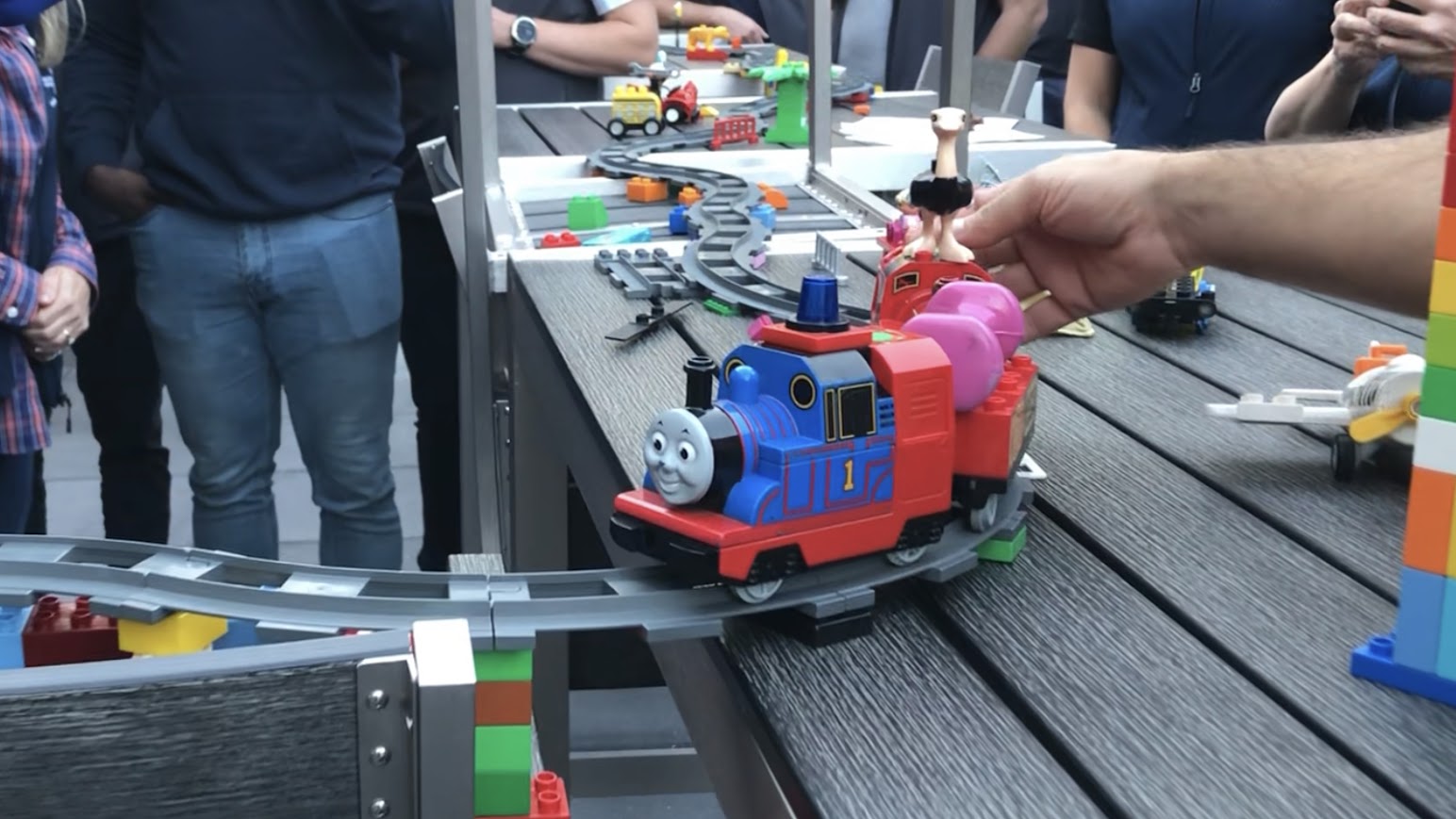
The closing activity of the two days involved building bridges in a different way. This was a group of senior leaders in an engineering company, who focus on geotechnical and structural monitoring for safety, so it seemed like a perfect fit to give them a few boxes of Duplo bricks and train tracks and task them with creating a safe path for Thomas the Tank Engine to make his way across several ravines from table to table and meet up with his friend James at the other end for James’ birthday party. Is Duplo intended for 2-5 year-olds rather than adult executives? Yes. Is Thomas the Tank Engine a character most closely associated with preschoolers? Yes. Did this group of executives have the time of their life working on this challenge? Also yes.
They each found the role that suited them best – while some designed the bridges, others built them; others made representations of geotechnical tools that would be used to survey the train track, while some used other materials to add scenes to each area of the track (Winnie the Pooh stood next to a fire truck, holding the hose in case a fire broke out on the track; meanwhile, Elsa and Anna rescued Olaf the snowman from an alligator by feeding it a steak instead). My personal favorite was the person who wrote in-depth invoices for all the materials used – “This is what I do every day!”, she told me.
The way this group fully engaged and became invested in the task at hand – cheering Thomas on as he made it over each bridge, shouting “come on buddy – you can do it!” – says a lot about the power of “serious play.” I heard from a couple of people that it brought back memories of childhood, and that it was building with materials like Duplo and Lego that led to their careers. But more widely, the post-event feedback showed that for many people, this activity was the most impactful. They worked as a group of 48 people, using preschool toys, to be creative and meet a challenge, and they had enormous fun doing it. In the midst of divisive times – with the expectation of more to come – they built bridges with each other and were reminded of how well they can work together.
How might this idea of Serious Play be helpful to your team this week?
This Week’s Tip:
- Plan an activity for your team that is playful and childlike, and has some connections to the work you do together – however tenuous. If you‘d like some partnership in coming up with an activity or in running it, reach out to us – we’d be happy to help. If you run the activity yourself, don’t be too wedded to the way you thought it might go (in the activity mentioned above, the participants came up with ideas I hadn’t considered, and I was faced with whether to say no to their ideas, but letting them explore and see what would come out of it was a more fruitful outcome). If there’s an end goal in mind, make it a stretch but also attainable for success and celebration in the first round. You can always add extra challenges afterwards if there’s time (I added extra weights to Thomas and gave them extra time and materials to make their bridges stronger).
- Debrief the activity (loosely – don’t take it too seriously), and look for connections to the work you do as a team. Ask a few open-ended questions – “What worked well for us?”, “Who’d like to share about how you approached this?”, “How does this relate to our work?” – and see what comes up. You might be surprised.
Try this out this week and let us know how it goes – we’d love to hear what you learn about yourself and others as you do.
You can subscribe to our feed here, or sign up for our weekly newsletter to get these articles directly in your inbox.
 Building Bridges Leadership